
SEO & Blogging
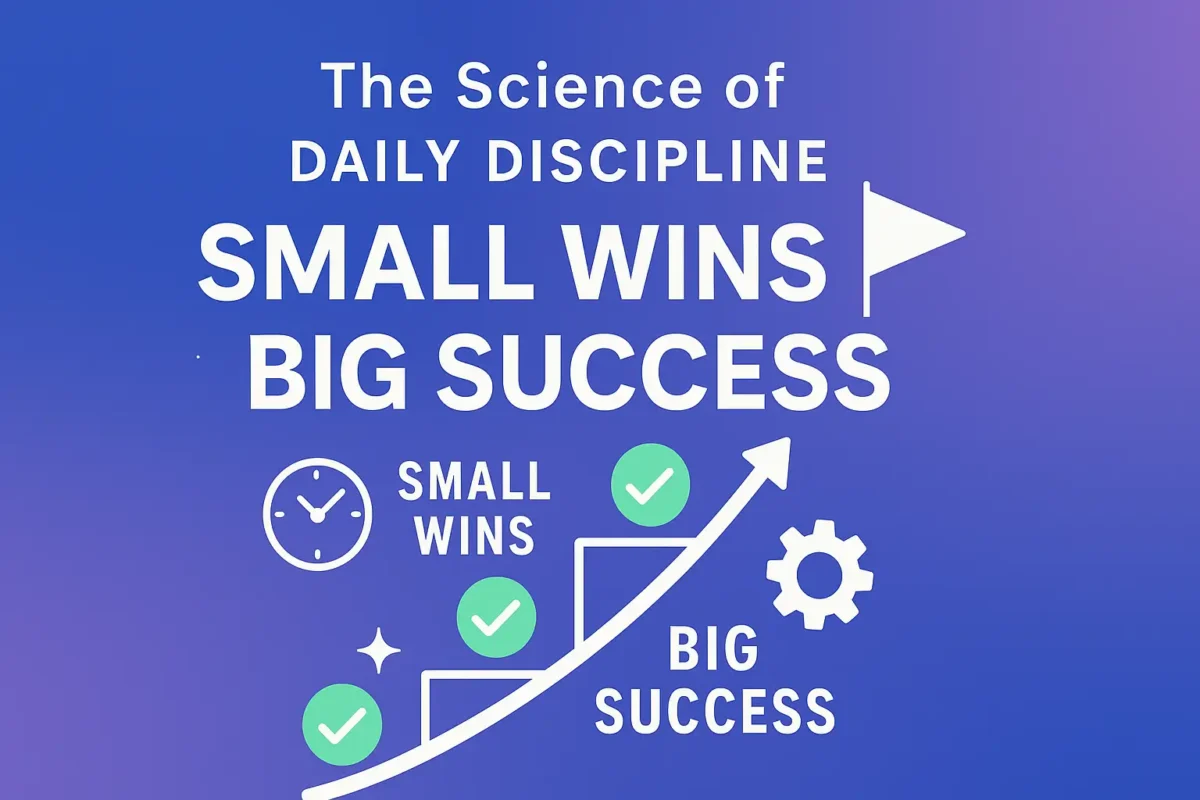
The Science of Daily Discipline: How Small Wins Create Big Success
Introduction: Why Discipline Matters More Than Motivation
We often wait for motivation to strike before we act. We tell ourselves, “I’ll start tomorrow,” “I just need to feel ready,” or “Once I’m inspired, I’ll do it.” But science tells a different story — motivation is fleeting, while discipline is repeatable. The world’s most successful people don’t rely on motivation. They rely on small, consistent actions that compound over time.
In a culture obsessed with quick results, daily discipline might seem old-fashioned, even boring. But beneath the surface lies a powerful truth: small wins create big success — not overnight, but over time.
In this article, we’ll explore the psychology and neuroscience behind daily discipline, why it works, and how you can apply the “small wins” effect to transform your habits, mindset, and long-term success.
1. The Science Behind Daily Discipline
Discipline isn’t just a character trait; it’s a neurological process. Every decision you make — whether to hit snooze or get up, to eat junk food or stick to your plan — strengthens or weakens specific neural pathways in your brain.
🧠 Habit Formation in the Brain
According to research from MIT, habits are formed through a loop involving three key components:
Cue – a trigger that initiates behavior.
Routine – the actual action or behavior.
Reward – the positive feeling or benefit that reinforces repetition.
When repeated enough, this loop shifts from conscious decision-making (in the prefrontal cortex) to the basal ganglia, a brain region responsible for automatic behavior. That’s why disciplined people don’t necessarily have more willpower — they’ve simply trained their brain to make good choices automatic.
🧩 The Power of Repetition
Neuroscientists call this process neuroplasticity — the brain’s ability to reorganize itself by forming new connections. Every time you repeat a productive action, such as exercising or writing daily, you’re literally reshaping your brain to make that behavior easier next time.
Consistency rewires you. And that’s the essence of daily discipline.
2. Why “Small Wins” Matter More Than Big Goals
We’re taught to set massive goals: “Lose 50 pounds,” “Earn six figures,” “Publish a book.” But these goals often create pressure, not progress. When results don’t show up fast enough, motivation fades.
The antidote? Small wins.
🌱 The Psychology of Small Wins
According to Harvard researcher Teresa Amabile, small, meaningful progress triggers the progress principle — the most powerful motivator in the human brain. Each small success releases dopamine, the “reward” neurotransmitter that boosts confidence and keeps you going.
When you make your goals smaller — like writing one paragraph a day or doing five pushups — you activate a continuous feedback loop of achievement. This keeps momentum alive, even on hard days.
“Success is the sum of small efforts repeated day in and day out.” — Robert Collier
⚙️ The Math of Momentum
One small improvement (1%) compounded daily can lead to massive transformation.
Mathematically:
Improve by 1% each day, and after a year you’ll be 37 times better than when you started.
Neglect by 1% each day, and you’ll decline nearly to zero.
Discipline doesn’t demand giant leaps — only consistent steps.
3. Why Willpower Alone Doesn’t Work
You’ve probably tried to “push through” a goal using pure willpower. It works… for a while. Then exhaustion sets in, and you revert to old habits.
That’s because willpower is a finite resource. Psychologists call this ego depletion — the idea that self-control weakens after extended effort.
So instead of depending on motivation or willpower, successful people build systems that make disciplined actions automatic.
🔄 Replace Willpower with Systems
Environment Design: Set up your surroundings so the right choice is the easy one. (e.g., put your running shoes by the door.)
Implementation Intentions: Instead of vague goals like “I’ll work out,” use specific plans: “I’ll jog for 20 minutes at 7 a.m.”
Identity Shifts: Say, “I am a disciplined person,” not “I’m trying to be disciplined.” The brain follows your identity.
“You don’t rise to the level of your goals; you fall to the level of your systems.” — James Clear
Discipline thrives not from constant self-control but from structure and predictability.
4. Building Daily Discipline Through Small Wins
Let’s move from science to application. Here’s how to translate the “small wins” philosophy into your everyday life.
Step 1: Choose One Core Habit
Don’t overwhelm yourself by changing ten things at once. Choose one meaningful action that supports your long-term vision — such as journaling, reading, or exercising daily.
Step 2: Shrink the Habit
Start embarrassingly small. If your goal is to read more, commit to just one page a day. This reduces mental resistance and gets you started — which is 90% of the battle.
Step 3: Track Your Wins
Humans are visual creatures. Tracking progress — even with simple checkmarks — boosts dopamine and keeps motivation alive. (We’ll dive deeper into tracking in your upcoming article The Ultimate Guide to Habit Tracking.)
Step 4: Reward Consistency, Not Perfection
Missing one day isn’t failure; quitting is. Discipline is built on returning to the habit, not being perfect. Celebrate streaks, not outcomes.
Step 5: Reflect Weekly
Ask yourself:
What worked this week?
What distracted me?
What will I adjust next week?
Reflection keeps your growth conscious and adaptive.
5. Real-World Examples: Small Wins That Changed Everything
🏃♂️ Example 1: The 1% Rule of British Cycling
For years, the British cycling team was mediocre. Then coach Dave Brailsford introduced the concept of marginal gains — improving every process by just 1%. They optimized everything: seat ergonomics, sleep quality, even hand-washing habits.
Result? Within five years, they dominated the Tour de France and Olympic events.
✍️ Example 2: The Daily Writing Habit
Stephen King writes 2,000 words every day — even on holidays. He doesn’t wait for inspiration; he trusts routine. Over decades, this small, consistent practice produced more than 60 bestselling novels.
💪 Example 3: Fitness Transformation Through Micro Habits
Instead of aiming to “lose 30 pounds,” successful individuals often start with a two-minute workout habit. Once the brain adapts to the identity of being “a person who moves daily,” scaling up becomes effortless.
Small wins compound silently until they explode visibly.
6. The Habit Loop and Consistency System
To sustain discipline, you need a reliable framework — a system that transforms effort into automation.
🔁 The Consistency Code Formula
Cue: Anchor the habit to something you already do (e.g., “After brushing my teeth, I’ll meditate for one minute.”)
Action: Keep it small and repeatable.
Reward: Celebrate instantly — a deep breath, a smile, or ticking your tracker.
Reflect: Weekly check-ins to adjust goals.
When repeated enough, this loop becomes your Consistency Code — your personal operating system for success.
7. Common Mistakes That Destroy Discipline
Starting too big: Overambitious goals trigger burnout.
Skipping reflection: Without feedback, you repeat errors unconsciously.
Ignoring identity: Trying to act disciplined without becoming disciplined is unsustainable.
Chasing motivation: You don’t need to feel good to do good. Action creates emotion — not the other way around.
8. Daily Tools to Reinforce Discipline
Habitica / Todoist: Turn habits into game-like challenges.
Notion / Trello: Build visual progress trackers.
Forest App: Stay focused using time-blocking.
Google Calendar: Schedule habits like non-negotiable appointments.
The right tools act as external discipline — guiding you when motivation fades.
9. The Neuroscience of Consistency: How the Brain Learns to Stay Disciplined
When you repeat small actions every day, something extraordinary happens inside your brain — neurons start firing together and wiring together.
This principle, known as Hebb’s Law, explains how discipline gradually becomes part of your identity. Each time you follow through on a promise — even something small like drinking water instead of soda — your brain strengthens that neural connection.
Over time, this transforms your behavior from effortful discipline into effortless habit.
🧠 The Role of Dopamine
Dopamine is often misunderstood as the “pleasure chemical.” In reality, it’s the motivation molecule. It spikes not when you achieve success, but when you anticipate it.
That’s why tracking small wins works so well: every checkmark or completed task releases a dopamine burst that tells your brain, “Keep going — this feels good.”
Small wins literally train your brain to crave consistency.
10. Emotional Discipline: Mastering Your Inner State
Discipline isn’t just about doing — it’s about feeling the right way while doing. Emotional regulation plays a massive role in sustaining consistency.
💡 Emotional Awareness
Most people give up not because the habit is too hard, but because they misinterpret discomfort as failure. When you start a new habit, your brain resists change — it releases stress hormones like cortisol, creating emotional friction.
By recognizing that friction as growth rather than failure, you reframe struggle into progress.
🧘♂️ Practical Strategies for Emotional Discipline
Mindful Pause: When you feel resistance, stop, breathe, and acknowledge the feeling without reacting.
Name the Emotion: Labeling your feelings (“I’m anxious,” “I’m tired”) reduces their power, according to research from UCLA.
Use the 10-Minute Rule: Tell yourself you’ll do the task for just ten minutes. Once started, momentum takes over.
Emotional mastery is the bridge between intention and consistent action.
11. The Feedback Loop of Progress
Progress isn’t linear — it’s a loop. When you track your actions, reflect on them, and adjust, you create a self-reinforcing cycle of growth.
🔁 The Three-Part Feedback Loop
Action: Perform a small, intentional habit daily.
Reflection: Measure your outcome — what improved? what didn’t?
Adaptation: Adjust the next action based on reflection.
Over time, this loop leads to exponential growth, not just incremental change.
“What gets measured gets managed.” — Peter Drucker
Even in psychology, data supports this: people who self-monitor their habits are twice as likely to achieve their goals compared to those who don’t track at all.
12. The Hidden Power of Accountability
Humans are social creatures. While discipline starts internally, it grows faster with external support.
🤝 Accountability Partners
Sharing your goals with someone you trust increases your success rate by up to 65%. Scheduling weekly check-ins or progress updates makes consistency feel like a shared mission, not a lonely struggle.
🧭 Public Commitment
Announcing your goals publicly — like posting a 30-day challenge online — activates your brain’s reputation circuitry. You subconsciously work harder to maintain integrity with your public identity.
🗓 Group Momentum
If you can, join a community of like-minded people. Whether it’s a book club, fitness group, or productivity circle, community energy creates sustainable motivation.
Accountability transforms discipline from a private effort into a public promise.
13. Advanced Systems: Automating Your Discipline
To make discipline sustainable, you must remove as many decision points as possible. Each unnecessary decision drains mental energy — a concept called decision fatigue.
⚙️ System #1: The “If–Then” Automation
Pre-decide your actions:
“If it’s 6 a.m., then I go for a jog.”
“If I feel distracted, then I take three deep breaths.”
This simple rule-based mindset eliminates hesitation — your brain no longer debates; it just executes.
⚙️ System #2: Habit Stacking
Pair a new habit with an existing one.
After pouring my morning coffee, I’ll open my journal.
After closing my laptop, I’ll review tomorrow’s plan.
This leverages existing neural cues to build new behaviors effortlessly.
⚙️ System #3: Environment Design
Shape your surroundings to make the right actions easy:
Keep your phone out of the bedroom.
Prep your workout clothes at night.
Place your eBook or reading app on your home screen.
Environment beats motivation — every single time.
14. From Discipline to Flow
Once discipline becomes ingrained, it evolves into a state called flow — the psychological zone of peak performance where time disappears and focus becomes effortless.
Psychologist Mihály Csíkszentmihályi describes flow as the sweet spot between challenge and skill. When you maintain daily discipline, your brain adapts to operate more frequently in this zone.
🌊 Signs You’re Entering Flow
You lose track of time while working.
You feel fully absorbed in the task.
Progress feels rewarding in itself.
The bridge to flow is discipline. You can’t enter flow without first building the routine that leads to it.
15. How Small Wins Create Massive Confidence
Confidence doesn’t come from success — it comes from evidence of success.
Each small win tells your subconscious:
“I can do this.”
That repeated message reshapes your self-image from someone trying to someone becoming.
🔑 The Confidence-Discipline Loop
Discipline → Small Wins → Confidence → More Discipline
This creates upward momentum. Every action becomes fuel for the next one, building an unstoppable identity of progress.
16. Breaking Plateaus and Staying Consistent
At some point, every disciplined person hits a plateau — when effort no longer brings visible results. This is where most people quit.
But plateaus aren’t signs of failure; they’re signs of stabilization. Your brain and body are adapting.
🧩 How to Break Through
Change the Environment: A small shift — like working in a new location — refreshes your brain.
Increase the Challenge Gradually: Add 5–10% difficulty (extra reps, extra pages, extra focus time).
Review Your Why: Reconnect with your purpose to reignite internal drive.
Plateaus test your patience, not your potential.
17. The Long-Term Impact of Daily Discipline
Small wins don’t just build habits — they build character. Over months and years, discipline compounds into self-respect, resilience, and purpose.
🌱 What Daily Discipline Gives You
Clarity: You stop guessing what to do next.
Control: You manage time and energy consciously.
Confidence: You trust your own follow-through.
Freedom: Once habits run automatically, you gain mental space for creativity.
“First we make our habits, then our habits make us.” — Charles C. Noble
18. Integrating “The Consistency Code” Into Your Life
Everything you’ve read so far can be summarized into one timeless principle:
Small actions, repeated daily, create extraordinary results.
This is the foundation of The Consistency Code — a framework built not on motivation or perfection, but on science-backed strategies that make success predictable.
Inside The Consistency Code eBook, you’ll discover:
A practical 5-step system for mastering discipline
Real-world habit templates used by high performers
The neuroscience of habit stacking and identity change
Printable habit trackers and reflection worksheets
A 30-day consistency challenge to reprogram your routine
It’s not about doing more — it’s about doing what matters, consistently.
19. Common Myths About Discipline (and the Truth Behind Them)
❌ Myth 1: Discipline means working hard all the time.
Truth: Real discipline is about working smart consistently, not pushing until burnout.
❌ Myth 2: You need motivation to get started.
Truth: Motivation follows action — not the other way around. The first step creates momentum.
❌ Myth 3: Successful people are naturally disciplined.
Truth: They built systems that make discipline easy. You can too.
❌ Myth 4: Missing a day means failure.
Truth: Progress is built on persistence, not perfection.
Understanding these truths frees you from guilt and helps you focus on what truly matters — showing up.
20. Building Your Personal Consistency System
Let’s summarize the framework you can start using today:
Define Your Identity: Decide who you want to become, not just what you want to achieve.
Pick One Keystone Habit: Choose a daily habit that anchors other positive behaviors.
Make It Easy: Reduce friction by starting small and simplifying the process.
Track Your Progress: Use visual trackers to see evidence of consistency.
Reflect Weekly: Adjust your plan every 7 days to prevent autopilot stagnation.
Celebrate Micro Wins: Reinforce success through positive reinforcement.
Consistency isn’t about effort — it’s about alignment. When your systems reflect your values, discipline becomes natural.
🔥 Final Call to Action: Start Living The Consistency Code
You now understand how daily discipline transforms small wins into lasting success.
But knowledge without action is wasted potential.
Take the next step today:
👉 Download your free copy of The Consistency Code eBook
and learn the proven methods to:

Rewire your brain for consistency
Turn effort into automatic habit
Build unstoppable momentum toward your goals
✨ Success isn’t magic — it’s mathematics. Small wins multiplied by time equal transformation.
[/ux_text]